The integration of Artificial Intelligence (AI) into the operations of financial enterprises has redefined industry standards, fostering efficiency, innovation, and improved customer experiences. In this article, we will delve into the diverse AI applications and use cases spanning various departments within a financial enterprise, with a specific focus on Customer Service, Retail Banking, Commercial Banking, Investment Banking, and Legal Compliance.
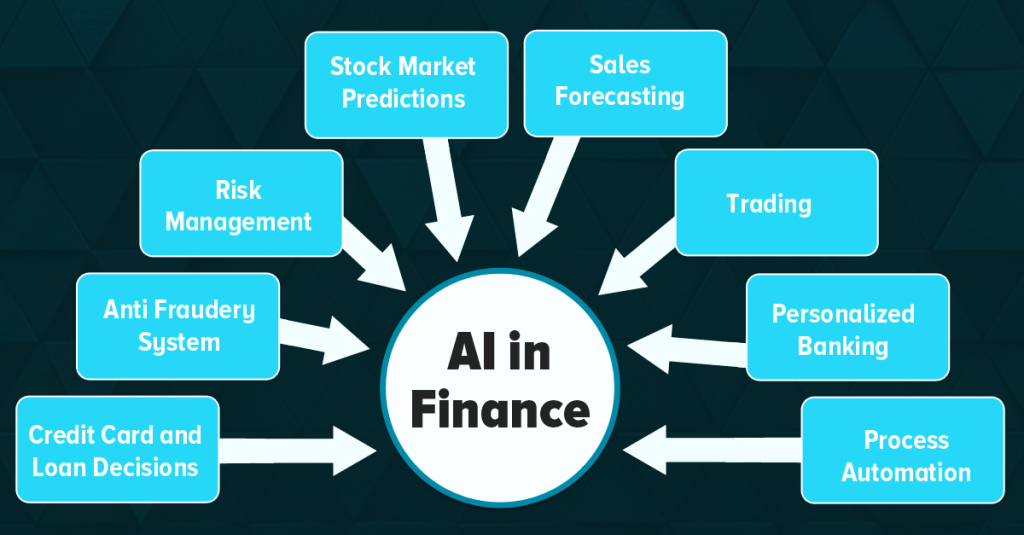
AI use cases in finance are discussed below.
1. Customer Service
1.1 The Role of AI in Enhancing Customer Service
Customer service is a pivotal aspect of the financial industry, influencing customer satisfaction and loyalty. AI technologies, particularly chatbots and virtual assistants, are revolutionizing the way financial institutions interact with their customers.
1.2 AI-powered Chatbots for Instant Support
AI-driven chatbots provide instant support to customers by handling routine queries, processing transactions, and offering information on account balances and recent transactions. These chatbots leverage Natural Language Processing (NLP) to understand and respond to user queries, creating a seamless and responsive customer service experience.
1.3 24/7 Availability and Personalization
The round-the-clock availability of AI-powered chatbots ensures that customers can access assistance whenever they need it. Moreover, these systems continuously learn from user interactions, allowing for personalized responses based on individual customer behavior and preferences.
2. Retail Banking
2.1 Transforming Retail Banking with AI
In retail banking, AI applications are optimizing processes and services, contributing to enhanced operational efficiency and improved customer satisfaction.
2.2 Automated Loan Approvals for Faster Processing
AI plays a crucial role in automating loan approval processes. By analyzing a diverse range of data, including credit scores and transaction history, AI algorithms expedite the decision-making process, providing faster approvals and contributing to a more responsive and customer-friendly retail banking experience.
2.3 Personalized Recommendations for Increased Cross-Selling
AI-driven analytics tools analyze customer data to offer personalized product recommendations. Retail banks can leverage these insights to cross-sell relevant financial products and services, thereby increasing revenue and deepening customer relationships.
3. Commercial Banking
3.1 Streamlining Operations in Commercial Banking
AI applications in commercial banking focus on streamlining complex processes, mitigating risks, and optimizing financial operations for businesses.
3.2 Automated Risk Management for Enhanced Decision-Making
AI contributes significantly to automated risk management in commercial banking. By analyzing large datasets and identifying patterns, AI models assess and manage risks more effectively. This enables commercial banks to make informed decisions when providing loans and other financial services to businesses.
3.3 Fraud Detection and Prevention
Commercial banking transactions often involve substantial amounts, making them susceptible to fraudulent activities. AI-powered fraud detection systems can analyze transaction patterns and identify anomalies in real-time, providing robust protection against financial crimes and ensuring the integrity of commercial banking operations.
4. Investment Banking
4.1 Advancements in Investment Banking with AI
AI applications in investment banking focus on data analysis, predictive modeling, and portfolio optimization, providing invaluable tools for making informed investment decisions.
4.2 Robo-Advisors for Intelligent Investment Management
Robo-advisors, powered by AI algorithms, have revolutionized investment management in the banking sector. These systems analyze market trends, assess risk tolerance, and recommend diversified investment portfolios tailored to individual investors. This automated approach democratizes wealth management, making it accessible to a broader range of clients.
4.3 Market Trend Analysis for Proactive Decision-Making
AI’s ability to process vast amounts of financial data and analyze market trends in real-time empowers investment bankers to make proactive decisions. Predictive analytics enables a deeper understanding of market dynamics, facilitating the identification of investment opportunities and potential risks.
5. Legal Compliance
5.1 The Crucial Role of AI in Legal Compliance
Legal compliance is a critical aspect of financial enterprises, subject to a complex web of regulations. AI applications are instrumental in automating processes related to legal compliance, ensuring adherence to regulatory requirements.
5.2 AI-powered Contract Analysis for Efficient Compliance
AI-driven contract analysis tools automate the extraction and interpretation of key information from legal documents. This not only streamlines the compliance process but also enhances accuracy, mitigating legal risks associated with oversight and non-compliance.
5.3 Anti-Money Laundering (AML) Compliance
AI is particularly effective in addressing Anti-Money Laundering (AML) compliance requirements. Machine learning algorithms analyze large datasets to detect suspicious patterns and transactions, ensuring banks adhere to AML regulations and mitigate financial crime risks.
Conclusion
The integration of AI across various departments within a financial enterprise marks a transformative era for the industry. From enhancing customer service with AI-powered chatbots to streamlining processes in retail, commercial, and investment banking, and ensuring legal compliance with advanced contract analysis tools, generative AI applications in banking and finance are reshaping the financial landscape.
As financial institutions continue to adopt and adapt to these technologies, the potential for innovation and improved services is boundless. The ongoing exploration and implementation of AI-driven solutions will undoubtedly play a crucial role in shaping the future of the financial industry, creating a landscape that is not only more efficient and secure but also more customer-centric and compliant with regulatory standards.
 Future of AI
Leave a comment