Artificial Intelligence (AI) is revolutionizing the healthcare industry by introducing innovative solutions that enhance patient care, streamline processes, and improve overall efficiency.
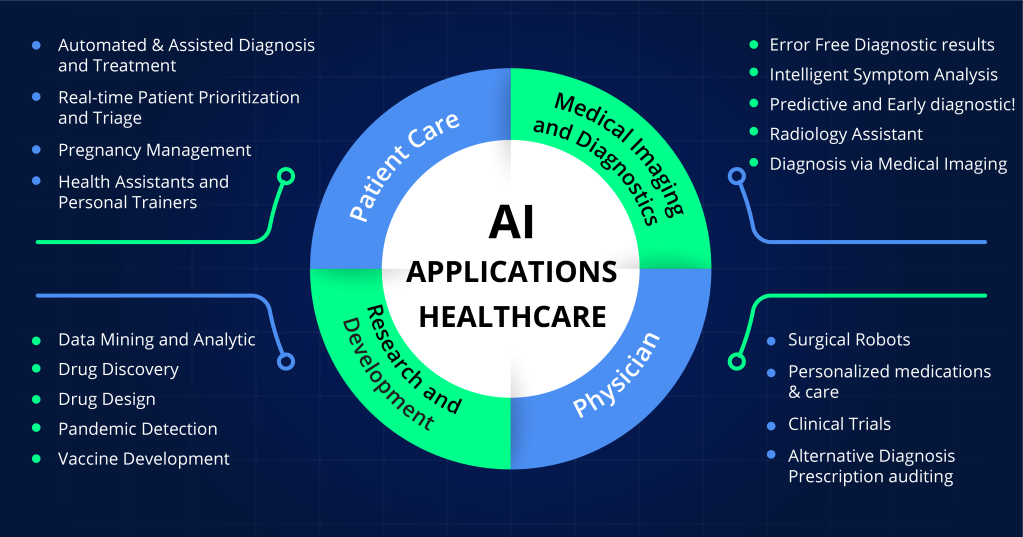
This article delves into some prominent AI use cases in healthcare, exploring their benefits and the potential they hold for the future.
1. Medical Imaging
Overview
Medical imaging is a critical component of healthcare diagnostics, enabling physicians to visualize and analyze internal structures of the body. AI applications in medical imaging involve the use of advanced algorithms to interpret and enhance medical images, such as X-rays, MRIs, and CT scans.
Benefits
- Accuracy: AI algorithms can detect abnormalities and subtle patterns that may be overlooked by human eyes, leading to more accurate diagnoses.
- Efficiency: Automation of image analysis reduces the time required for diagnosis, allowing healthcare professionals to make faster decisions.
- Early Detection: AI aids in early detection of diseases, contributing to timely interventions and improved patient outcomes.
Future Outlook
The future of medical imaging with AI involves even more sophisticated algorithms, potentially enabling real-time analysis and personalized treatment plans based on individual patient data.
2. Personalized Treatment
Overview
Personalized treatment involves tailoring medical interventions to the unique characteristics of each patient. AI plays a crucial role in this domain by analyzing vast datasets to identify patterns, predict treatment responses, and recommend personalized therapies.
Benefits
- Optimized Treatment Plans: AI algorithms analyze genetic, clinical, and lifestyle data to create personalized treatment plans, maximizing effectiveness and minimizing side effects.
- Drug Discovery: AI accelerates drug discovery by analyzing molecular structures and predicting potential drug candidates, leading to the development of targeted therapies.
- Improved Outcomes: Personalized treatment approaches contribute to better patient outcomes and a more efficient healthcare system.
Future Outlook
The future holds the promise of AI-driven precision medicine, where treatments are tailored not only to genetic factors but also to dynamic changes in a patient’s health over time.
3. Electronic Health Records (EHRs)
Overview
Electronic Health Records (EHRs) are digital versions of patients’ paper charts, containing comprehensive information about their medical history, diagnoses, medications, and treatment plans. AI is increasingly utilized to extract valuable insights from these vast datasets.
Benefits
- Efficient Data Management: AI automates data entry, reducing the administrative burden on healthcare professionals and ensuring accurate and up-to-date information.
- Predictive Analytics: By analyzing EHR data, AI can predict disease trends, patient outcomes, and resource needs, enabling proactive healthcare management.
- Interoperability: AI contributes to the seamless exchange of information between different healthcare systems, improving collaboration and patient care.
Future Outlook
The future of EHRs involves more advanced AI applications, such as natural language processing for extracting insights from unstructured data and predictive modeling for personalized treatment recommendations.
4. Fraud Detection
Overview
Healthcare fraud is a significant concern, leading to financial losses and compromised patient care. AI-powered fraud detection systems analyze vast datasets to identify irregularities, suspicious patterns, and potential fraudulent activities.
Benefits
- Cost Savings: AI helps prevent financial losses associated with fraudulent claims, ensuring that resources are directed towards genuine patient care.
- Improved Compliance: Automated fraud detection systems enhance compliance with regulations and ethical standards, fostering trust in the healthcare system.
- Real-time Monitoring: AI enables real-time monitoring of transactions and activities, allowing prompt intervention in case of suspicious behavior.
Future Outlook
The future of fraud detection in healthcare involves the integration of machine learning models that continuously adapt and evolve to stay ahead of increasingly sophisticated fraudulent tactics.
5. Virtual Assistants and Chatbots
Overview
Virtual assistants and chatbots powered by AI are transforming patient engagement, providing instant support, answering queries, and even assisting in preliminary medical assessments.
Benefits
- 24/7 Accessibility: Virtual assistants offer round-the-clock support, improving accessibility for patients seeking information or assistance.
- Cost-effective Triage: AI-driven chatbots can assess symptoms, provide initial recommendations, and prioritize patients based on the urgency of their condition, optimizing healthcare resources.
- Enhanced Patient Experience: Instant and personalized interactions contribute to an improved overall patient experience and satisfaction.
Future Outlook
The future of virtual assistants and chatbots in healthcare involves enhanced natural language processing capabilities, emotional intelligence, and integration with other AI systems for more comprehensive patient support.
6. Remote Patient Care
Overview
Remote patient care, facilitated by AI, allows healthcare providers to monitor and manage patients’ health outside traditional clinical settings. This is particularly crucial for chronic disease management and post-surgery recovery.
Benefits
- Continuous Monitoring: AI-powered devices enable continuous monitoring of vital signs, ensuring timely intervention in case of abnormalities.
- Patient Empowerment: Remote care empowers patients to actively participate in their healthcare, leading to better adherence to treatment plans and improved outcomes.
- Resource Optimization: By reducing the need for frequent hospital visits, AI-driven remote patient care optimizes healthcare resources and lowers costs.
Future Outlook
The future of remote patient care involves the integration of AI with Internet of Things (IoT) devices, wearables, and smart sensors to provide even more comprehensive and real-time health data.
Conclusion
Artificial Intelligence is undeniably transforming the landscape of healthcare, offering a myriad of benefits across various domains. From improving the accuracy of medical diagnoses to enabling personalized treatment plans, enhancing data management, detecting fraud, and revolutionizing patient interactions, the applications of AI in healthcare are both diverse and promising. As technology continues to advance, the future holds the potential for even more sophisticated and impactful AI solutions that will further revolutionize patient care and healthcare delivery. Embracing these innovations is not just a choice but a necessity for a healthcare system that aspires to be more efficient, accessible, and patient-centric.
 Future of AI
Leave a comment