Artificial Intelligence (AI) has rapidly transformed various sectors, and healthcare is no exception. Among the different branches of AI, generative AI stands out for its ability to create new data and insights, making it particularly promising in healthcare applications.
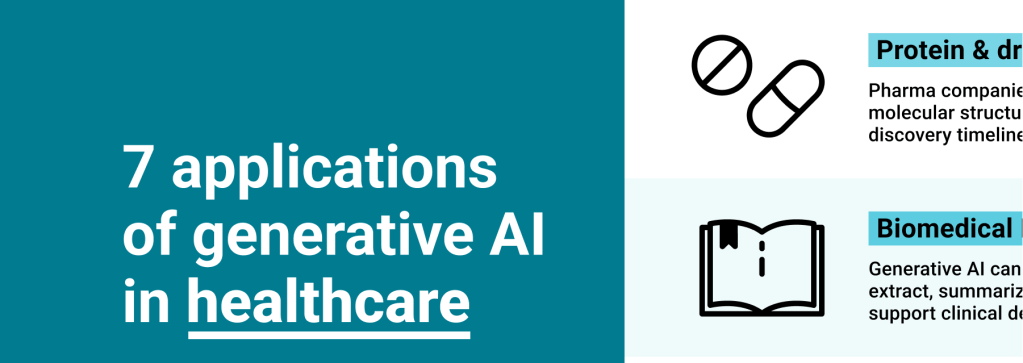
In this article, we explore the diverse applications of generative AI in healthcare, focusing on medical imaging, drug discovery and development, personalized medicine, medical research and data analysis, administrative tasks, and risk prediction for pandemic preparedness.
Medical Imaging
Generative AI has revolutionized medical imaging by enhancing the quality of diagnostic procedures and improving patient outcomes. Techniques such as Generative Adversarial Networks (GANs) and Variational Autoencoders (VAEs) are used to generate high-resolution images from low-quality or incomplete scans, aiding in the detection and characterization of diseases. For instance, GANs can be employed to generate synthetic magnetic resonance imaging (MRI) or computed tomography (CT) images, which can supplement limited datasets and improve the accuracy of diagnoses. Moreover, generative AI enables the synthesis of diverse imaging modalities, facilitating multi-modal analysis and comprehensive patient assessments.
Drug Discovery and Development
Generative AI accelerates the drug discovery and development process by facilitating the rapid exploration of vast chemical space and identifying promising drug candidates. Through deep learning algorithms trained on molecular databases, generative models can generate novel molecular structures with desired pharmacological properties. These generated molecules can then be synthesized and evaluated for their efficacy and safety, potentially reducing the time and cost associated with traditional drug development pipelines. Additionally, generative AI enables the optimization of existing drugs by generating analogs with improved potency, selectivity, or bioavailability, thereby expanding the repertoire of therapeutic options available to patients.
Personalized Medicine
Personalized medicine aims to tailor medical treatments to individual patients based on their unique genetic makeup, physiological characteristics, and environmental factors. Generative AI plays a crucial role in personalized medicine by analyzing large-scale patient data and generating patient-specific models for diagnosis, treatment planning, and outcome prediction. By integrating genomic information, electronic health records, and other clinical data sources, generative models can generate personalized risk profiles, predict treatment responses, and optimize therapeutic interventions. Furthermore, generative AI enables the creation of virtual patient avatars for simulation-based training and personalized medical education, empowering healthcare professionals to deliver targeted and effective care.
Medical Research and Data Analysis
Generative AI facilitates medical research and data analysis by generating synthetic datasets, simulating biological processes, and generating hypotheses for further investigation. By learning from existing data, generative models can generate new samples that capture the underlying distribution of biological phenomena, enabling researchers to explore complex relationships and identify novel biomarkers or disease mechanisms. Moreover, generative AI can assist in data augmentation, anomaly detection, and pattern recognition tasks, enhancing the efficiency and reliability of biomedical research. Additionally, generative models enable the generation of realistic synthetic data for training and validation purposes, addressing privacy concerns and data scarcity issues in healthcare research.
Administrative Tasks
Generative AI streamlines administrative tasks in healthcare by automating document generation, speech recognition, and natural language processing tasks. For example, generative models can generate clinical reports, discharge summaries, or patient notes based on structured data inputs, reducing the administrative burden on healthcare professionals and improving documentation accuracy. Furthermore, generative AI enables conversational agents or chatbots to assist patients with appointment scheduling, medication reminders, and basic healthcare inquiries, enhancing the overall patient experience and efficiency of healthcare delivery.
Risk Prediction and Pandemic Preparedness
Generative AI aids in risk prediction and pandemic preparedness by analyzing epidemiological data, modeling disease spread, and simulating potential scenarios. By leveraging machine learning algorithms trained on historical outbreak data, generative models can forecast disease trajectories, identify high-risk populations, and inform public health interventions. Additionally, generative AI enables the generation of synthetic epidemic scenarios for scenario planning and response preparedness, enabling policymakers and healthcare authorities to develop proactive strategies and allocate resources effectively. Moreover, generative models can assist in vaccine development by predicting antigenic variations, designing candidate vaccines, and optimizing vaccination strategies to mitigate the impact of emerging infectious diseases.
Conclusion
Generative AI holds immense promise in revolutionizing healthcare across various domains, from medical imaging and drug discovery to personalized medicine and pandemic preparedness. By harnessing the power of deep learning and data-driven insights, generative models enable healthcare practitioners to deliver more accurate diagnoses, develop innovative therapies, and improve patient outcomes. However, challenges such as ethical considerations, regulatory compliance, and data quality remain important considerations in the deployment of generative AI in healthcare. Through interdisciplinary collaboration, responsible innovation, and continued research, generative AI has the potential to transform healthcare delivery and address some of the most pressing challenges facing global health.
 Future of AI
Leave a comment